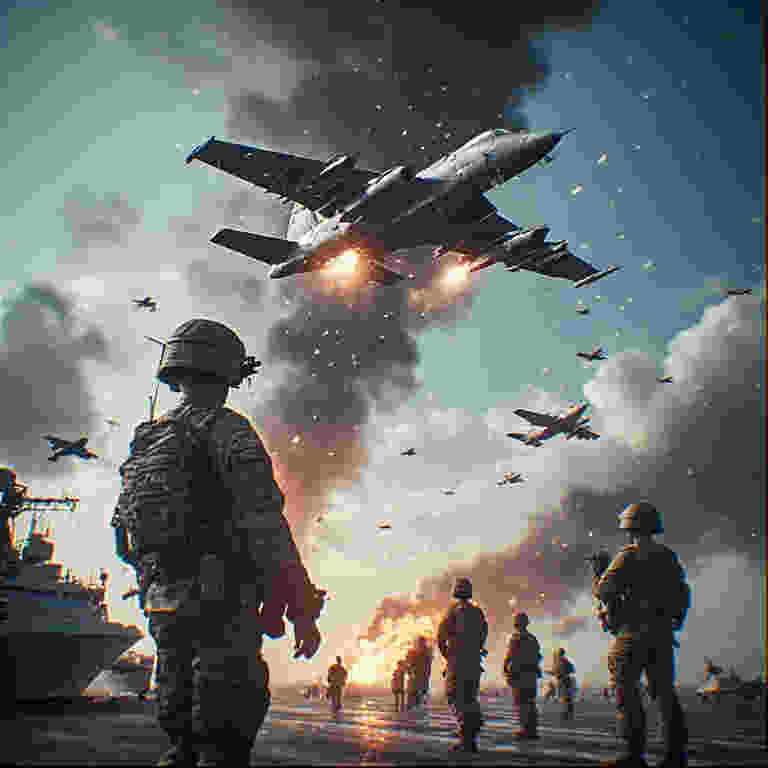
War’s Impact on Financial Assets: Mechanisms and Market Dynamics
Introduction: War as a Market Force
War represents one of the most profound and complex forces affecting financial markets. Unlike economic cycles or policy changes, armed conflict introduces fundamental disruptions to the basic structures of production, trade, and economic security. The relationship between war and financial assets is not uniform—it depends on the conflict’s location, duration, intensity, and the specific exposure of different economies and market sectors.
This article examines how wars affect various asset classes, the mechanisms through which these impacts occur, and how different market participants interpret and respond to conflict-related developments. This is not Financial advice and not financial prediction, just and opinion.
The General Economic Impact of War
Macroeconomic Contraction
According to the examining of 115 conflicts across 145 countries over 75 years, it reveals that wars impose large and persistent economic costs :
- GDP Decline: Real GDP falls by approximately 12% on average over ten years for countries directly involved in conflict, with the contraction deepening from about 3.3% at onset to 16% after a decade
- Investment Collapse: Real investment drops by around 13%, with real domestic credit falling by 20%—exceeding the output loss
- Trade Disruption: Exports fall by 12% and imports by 7%, with the current account deteriorating by approximately $2.1 billion
These effects are particularly severe in low-income countries with shallow financial markets, where investment falls more sharply and trade disruptions are larger.
Fiscal and Monetary Consequences
Wars fundamentally strain public finances :
- Revenue Collapse: Real government revenues fall by about 14%
- Expenditure Persistence: Government spending remains relatively stable, creating fiscal pressure
- Debt Structure Shift: The share of long-term debt falls as governments shift toward short-term financing, increasing rollover risk
- Inflationary Finance: In the decade following conflict onset, consumer prices rise by approximately 62%, consistent with governments monetizing deficits
Crucially, research indicates these economic scars are not temporary—there is no evidence of recovery even a decade after conflict ends.
Impact on Specific Asset Classes
See also : What Determines the Effectiveness of Safe-Haven Asset in Wartime
1. Forex Markets: The Currency Response to Conflict
Currency markets react swiftly to geopolitical tensions, with movements reflecting both immediate safe-haven flows and longer-term shifts in economic fundamentals.
Safe-Haven Currency Dynamics
As example, during the March 2026 Iran conflict, immediate currency movements illustrated classic wartime patterns :
| Currency | Response | Primary Driver |
|---|---|---|
| U.S. Dollar | Strengthened broadly | Global safe-haven demand |
| Swiss Franc | Climbed 0.6% against euro (strongest since 2015) | Traditional safe haven |
| Japanese Yen | Initially rose, then weakened | Safe-haven demand offset by oil import dependence |
| Euro | Fell 0.3% to $1.1781 | Energy import vulnerability |
| Sterling | Slid more than 0.5% | Risk-off sentiment |
| Australian Dollar | Dropped 0.7% | Risk-sensitive commodity currency |
| Chinese Yuan | Fell about 0.2% offshore | Energy importer, main buyer of Iranian oil |
| Canadian Dollar | Steady | Oil exporter |
See also : As US Win or Lose the War, What Assets Will be Affected?
Link to Major Forex Pairs
The major forex pairs exhibit distinct sensitivities to conflict:
- EUR/USD: Particularly vulnerable when conflicts threaten energy supplies, as Europe’s dependence on imported energy creates structural weakness during Middle East tensions. Wells Fargo analysts noted during the Iran crisis that “the euro is in a difficult spot” because Europe’s natural gas storage refill season coincided with potential energy price spikes.
- USD/JPY: The yen’s traditional safe-haven status can be undermined when conflicts drive oil prices higher, given Japan’s massive energy import requirements. During the Iran escalation, the yen was “held back by Japan’s big oil imports,” initially rising but ultimately trading weaker.
- Commodity Currencies (AUD, CAD, NOK): These respond to conflict through two channels: risk sentiment (generally negative) and commodity price movements (positive for exporters of affected commodities). The Australian dollar fell sharply during the Iran crisis as risk-off sentiment dominated, while the Canadian dollar remained steady, reflecting its oil exporter status.
- USD/CHF: The Swiss franc consistently strengthens during conflicts as capital seeks its traditional safe-haven status, often reaching multi-year highs against both dollar and euro.
2. Stock Markets: Equity Response to Conflict
See also : The Impact of War on Stock Markets
Historical Pattern: Initial Decline, Subsequent Recovery
Historical analysis of major conflicts reveals a consistent pattern: markets initially stumble on uncertainty but often recover and even outperform over longer horizons.
| Event | Date | Dow Jones One-Year Change |
|---|---|---|
| World War II begins | 1/9/1939 | -4.07% |
| Pearl Harbour attack | 7/12/1941 | +2.20% |
| North Korea invades South Korea | 25/6/1950 | +14.67% |
| Operation Desert Storm begins | 16/1/1991 | +29.52% |
| 9/11 terrorist attacks | 11/9/2001 | -3.81% |
| Operation Iraqi Freedom begins | 19/3/2003 | +23.24% |
| Russia invades Ukraine | 24/2/2022 | -1.22% |
Across six major conflicts from World War II to the Iraq and Afghanistan wars, U.S. stocks not only recovered but often outperformed their peacetime averages. During World War II, small-cap stocks surged by over 30%.
Why Stocks Can Rebound During Conflict
Several factors explain this counterintuitive resilience :
- Uncertainty Resolution: Markets hate uncertainty more than war itself. Once the initial shock passes and the fog begins to lift, markets begin pricing in the new reality.
- Government Spending: Conflicts typically increase government spending, particularly in defense and infrastructure, which can stimulate economic activity.
- Sector Beneficiaries: Certain sectors—energy, defense, manufacturing—may benefit directly from conflict-related demand.
Contemporary Example: Iran Conflict 2026
The March 2026 Iran conflict demonstrated immediate equity market reactions :
- U.S. stock futures plunged sharply, with S&P 500 futures down 1.6% and Nasdaq 100 contracts falling 2%
- Regional markets experienced significant declines—the Dhaka Stock Exchange index fell 2.47% in a single session
- Investors rushed to secure assets, creating broad selling pressure
However, analysts noted that the initial plunge was largely “a psychological reaction,” and sensible investors stepped in later to recover partial losses.
Sectoral Differentiation
Conflict creates distinct winners and losers across equity sectors :
| Sector | Impact | Mechanism |
|---|---|---|
| Energy | Positive for producers | Higher oil and gas prices |
| Defense/Aerospace | Positive | Increased government spending |
| Airlines | Negative | Higher fuel costs |
| Shipping/Logistics | Negative | Disrupted routes, higher insurance costs |
| Manufacturing | Negative | Higher input costs, supply chain disruption |
| Fertilizer/Chemicals | Negative | Rising naphtha and feedstock costs |
| Consumer Goods | Negative | Margin pressure from input cost inflation |
| Financials | Mixed | Credit concerns vs. higher interest rates |
3. Commodity Markets: The Front Line of Conflict Impact
Commodities are often the most directly and immediately affected asset class during conflicts, particularly when fighting occurs in resource-rich regions or disrupts critical transport routes.
Energy Commodities
Oil prices typically lead the market response to geopolitical tensions :
- Immediate Spike: Following the Iran strikes, oil prices leapt approximately 9% in early trading, with Brent crude approaching $80 per barrel
- Potential Trajectory: Analysts suggested that if WTI crude remained above the key technical level of $70.5, prices could potentially move toward $100 should the situation worsen
- Supply Disruption Mechanism: The Strait of Hormuz, through which about one-fifth of the world’s oil passes, effectively became a chokepoint with traffic slowing dramatically
The relationship between conflict and oil prices operates through multiple channels :
- Physical Supply Disruption: Direct damage to production facilities or infrastructure
- Transport Route Interruption: Closure of critical waterways like the Strait of Hormuz
- Risk Premium: Traders incorporating higher probability of future disruptions
- Inventory Behavior: Importers seeking to build strategic stocks
NYU energy expert Amy Myers Jaffe noted that “the biggest question is what, if any, oil installations get damaged”—if none are hit, prices might subsequently decline, but sustained conflict could keep prices elevated.
Natural Gas
Conflicts affecting gas-producing regions or LNG routes can have significant impacts :
- Regional Disparities: Europe faces particular vulnerability when conflicts threaten gas supplies, as its storage refill needs create structural demand
- LNG Market Effects: Liquefied natural gas shipped through conflict zones faces disruption risks, affecting global prices
Gold
Gold‘s response to conflict reflects its dual role as safe haven and inflation hedge :
- Immediate Haven Demand: Gold rose alongside the dollar as investors piled into safe assets during the Iran crisis
- Inflation Expectations: To the extent conflicts generate inflationary pressures, gold may benefit as a store of value
- Central Bank Behavior: Recent trends show central banks increasing gold purchases as a hedge against geopolitical and sanctions risk
See also : How War Influence the Prices of Gold and Bitcoin
Industrial Metals and Other Commodities
Conflicts can disrupt industrial metals through multiple channels :
- Supply Chain Effects: Shipping disruptions affect all commodities moving through conflict zones
- Demand Destruction: Economic contraction in affected regions reduces industrial consumption
- Cost-Push Inflation: Higher energy costs increase production expenses across all mined commodities
4. Bond Markets: Fixed Income Response to Conflict
Bond markets exhibit complex responses to conflict, reflecting competing forces of safe-haven demand and inflationary pressures.
Government Bonds
Safe-Haven Demand: During the Iran crisis, bonds rallied alongside the dollar as investors sought safety, with Treasury yields retreating. This traditional flight-to-quality response reflects capital moving into the most liquid, secure sovereign debt.
Inflation Concerns: However, the inflationary consequences of war create headwinds for bonds. The historical record shows that in the decade following conflict onset, consumer prices rise by about 62%, eroding the real value of fixed-income investments.
Fiscal Pressure: Wars strain government finances, with revenues falling while spending remains stable. This fiscal deterioration can increase sovereign credit risk, particularly for countries directly involved in conflict.
Corporate Bonds
Credit markets reflect the differentiated impact of conflict across sectors:
- Energy Sector: Bonds of oil and gas companies may benefit from improved cash flow prospects
- Transportation/Airlines: Face pressure from higher fuel costs and potential demand destruction
- Broad Corporate Credit: Rising input costs and supply chain disruption can compress margins, potentially increasing default risk for weaker credits
The Four Horsemen Framework
Financial historian Dr. Bryan Taylor identifies war as one of the four fundamental forces—the “Four Horsemen of Finance”—that explain long-term market returns across countries and periods :
| Force | Impact on Markets |
|---|---|
| Trade | Free trade fuels growth; restrictions dampen returns |
| War | Shifts economy from production to destruction; disrupts supply chains |
| Inflation | Devastates fixed-income investors; erodes real returns |
| Government | Can foster or stifle investment through policies |
The TWIG Theory (Trade, War, Inflation, Government) suggests that breaking any part of the TWIG can harm market returns.
How Market Participants Interpret Conflict
Initial Response vs. Sustained Impact
Market participants distinguish between immediate psychological reactions and longer-term fundamental effects :
- Initial Phase: Fear-driven selling, safe-haven flows, liquidity seeking
- Assessment Phase: Evaluating duration, intensity, and economic footprint
- Pricing Phase: Incorporating new reality into valuations
Analysts during the Iran conflict noted that “the initial reaction is mild risk off, and you’ve just got to take each day as it comes”. Similarly, observers noted that the market plunge was “largely a psychological reaction,” with sensible investors stepping in later to recover partial losses.
Key Questions Market Participants Ask
When conflict erupts, market participants typically seek answers to :
- Duration: How long will the conflict last? (The Iran campaign was initially framed as “about a four-week process”)
- Geographic Spread: Will it remain contained or expand to neighboring countries?
- Infrastructure Damage: Are critical production or transport assets being hit?
- Supply Chain Effects: Which trade routes are disrupted, and for how long?
- Policy Responses: How will central banks and governments react?
- Second-Order Effects: What are the implications for inflation, growth, and corporate profits?
The “Oil Trade” vs. “Gold Trade”
Market participants often debate which commodity represents the primary “war trade” :
- Oil: Viewed by some analysts as “the real trade during war times” because conflicts frequently disrupt supply from key producing regions
- Gold: Benefits from safe-haven demand and inflation expectations but may be secondary to energy commodities in conflicts centered on oil-producing areas
During the Iran crisis, analysts noted that oil was “actually breaking out” above key technical levels, suggesting it was the primary focus.
Geographic and Structural Vulnerabilities
Energy Importers vs. Exporters
Conflict impact varies dramatically based on a country’s energy position :
| Country Type | Vulnerability | Examples |
|---|---|---|
| Energy Importers | High—direct exposure to higher prices | Japan, South Korea, Taiwan, Singapore, Hong Kong, India, China, EU |
| Energy Exporters | Potentially positive—higher revenues | Canada, Norway, Gulf states |
High-income Asian economies that import more than 80% of their energy are particularly vulnerable to price shocks and supply disruptions.
Supply Chain Exposure
Countries and companies with concentrated exposure to conflict zones face elevated risk. India, for example, imports nearly 90% of its crude oil, with about 50% passing through the Strait of Hormuz, creating acute vulnerability to any disruption in that waterway.
Sectoral Concentration
Investors examine their exposure to sectors directly affected by conflict :
- Aviation: Direct fuel cost impact
- Shipping/Logistics: Route disruption, higher insurance
- Manufacturing: Input cost inflation, supply chain interruption
- Fertilizers/Chemicals: Feedstock cost pressure
- Consumer Goods: Margin compression
The Lasting Economic Scars of War
See also : Stock That May Gain in Post-War Periods: Historical Patterns and Considerations
Persistent Effects
Research emphasizes that war’s economic consequences are not temporary disruptions but “large, persistent, and multi-dimensional” :
- No Automatic Recovery: There is no evidence of economies bouncing back to pre-war trends even a decade after conflict
- Financial System Damage: Wars undermine the financial and monetary foundations on which modern economies rest
- Credit Constraints: Without access to credit, stable institutions, and affordable capital goods, economies may remain in slump for years
Reconstruction Challenges
The post-conflict reconstruction phase presents its own challenges :
- Capital Goods Imports: Large nominal depreciations following war (averaging over 100%) make imported capital goods more expensive, discouraging investment
- Fiscal Constraints: Depleted government resources limit reconstruction capacity
- Credit Access: War-damaged economies face difficulty accessing international credit
Conclusion
War’s impact on financial assets operates through multiple channels—immediate safe-haven flows in currencies, sectoral differentiation in equities, direct price effects in commodities, and complex sovereign credit dynamics in bonds. The historical record suggests that while markets initially react with fear and uncertainty, they often demonstrate remarkable resilience over longer horizons. However, the economic scars for directly affected countries are deep and persistent, with no automatic recovery even years after conflict ends.
For market participants across forex, stocks, commodities, and bonds, understanding these dynamics means distinguishing between:
- Immediate psychological reactions vs. sustained fundamental impacts
- Direct exposure (location, sector) vs. indirect effects (supply chains, inflation)
- Short-term volatility vs. long-term structural change
The most consistent lesson from history may be that while wars create uncertainty and disruption, the markets that survive and adapt have consistently rewarded patience and perspective over panic-driven reactions.
See also : What Determines the Effectiveness of Safe-Haven Asset in Wartime













2 comments