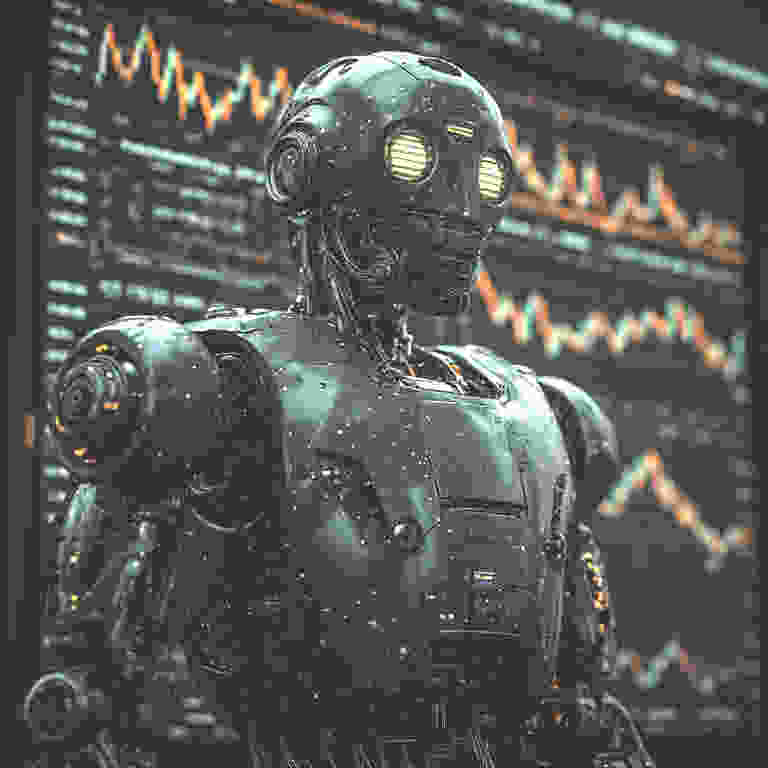
What are Algorithmic Trading and Quantitative Trading
Algorithmic Trading and Quantitative Trading represent the integration of advanced mathematics, statistical modeling, and computer science into the financial markets. These disciplines move beyond discretionary human decision-making, relying instead on systematic rules, data analysis, and automated execution to identify opportunities and manage risk. While often used interchangeably, they describe related but distinct approaches to modern, technology-driven finance. This article explains the definitions, methodologies, and key characteristics of both algorithmic and quantitative trading.
This article is not financial advice or trade advice, only an explanation.
Algorithmic Trading – The Automation of Execution
1.1 Core Definition
Algorithmic Trading (often called Algo Trading) refers to the use of computer programs and systems to automatically execute trading orders according to a predefined set of rules or instructions. The primary focus is on the efficient, precise, and rapid execution of a trading decision, which may originate from a human trader or a separate analytical model.
1.2 Key Objectives and Strategies
Algo trading is employed to achieve specific execution goals, minimizing market impact and transaction costs.
- Implementation Shortfall & Market Impact: Large orders can move the market if executed all at once. Algorithms break a large “parent” order into many smaller “child” orders and execute them strategically over time to minimize the price impact on the market. Common types include:
- Volume-Weighted Average Price (VWAP): Aims to execute orders at an average price close to the volume-weighted average price for the day.
- Time-Weighted Average Price (TWAP): Slices the order into equal parts executed at regular intervals.
- Percentage of Volume (POV): Executes orders at a rate set as a percentage of the market’s real-time trading volume.
- Arbitrage and Market-Making:
- Arbitrage: Algorithms can identify and exploit tiny, fleeting price discrepancies for the same asset across different exchanges or related assets in fractions of a second.
- Market-Making: Algorithms continuously provide buy (bid) and sell (ask) quotes to earn the bid-ask spread, providing liquidity to the market.
- High-Frequency Trading (HFT): A subset of algo trading characterized by extremely high speeds, high order-to-trade ratios, and very short holding periods (milliseconds to seconds). HFT firms compete on the nanosecond level via co-location (placing servers physically next to exchange servers) and sophisticated network technology.
1.3 Characteristics
- Focus: Execution methodology. It answers the “how” and “when” to trade.
- Input: A trading decision (e.g., “Buy 100,000 shares of Company X”).
- Output: An executed order in the market, optimized for cost and efficiency.
- Core Skill: Computer science, network latency optimization, and exchange microstructure knowledge.
Quantitative Trading – The Data-Driven Generation of Ideas
2.1 Core Definition
Quantitative Trading (or Quant Trading) is a broader approach that uses mathematical and statistical models to identify trading opportunities. It is research-driven and focuses on discovering predictive signals or patterns in historical and real-time data. The resulting model generates the trading signals (e.g., buy, sell, hold) which may then be executed manually or, more commonly, via an algorithmic execution system.
2.2 The Quantitative Research Process
Quant trading follows a rigorous, scientific workflow:
- Hypothesis Generation: A quant researcher develops a testable idea based on an observed market anomaly, economic theory, or pattern (e.g., “Stocks with low price-to-earnings ratios outperform over the long term” or “The yield curve slope predicts economic growth”).
- Data Acquisition & Cleaning: Vast datasets—market prices, fundamental data, alternative data (satellite imagery, credit card transactions, web traffic)—are gathered and rigorously cleaned.
- Model Development & Backtesting: A mathematical model is built to formalize the hypothesis. It is then tested on historical data (backtesting) to see if it would have been profitable and to assess its risk metrics (Sharpe ratio, maximum drawdown).
- Risk of Overfitting: A critical challenge is ensuring the model captures a genuine, repeatable market relationship and is not merely “curve-fitted” to random noise in the historical data.
- Implementation & Live Testing: The successful model is coded into a trading system, often with a risk management overlay, and run on a small scale with real capital (forward testing or paper trading) before full deployment.
2.3 Common Quantitative Strategies
- Statistical Arbitrage: Exploiting temporary deviations from a statistical relationship between assets (e.g., pairs trading, where two historically correlated stocks are traded when their price ratio diverges).
- Factor Investing & Smart Beta: Systematically selecting securities based on attributes (factors) believed to drive returns, such as value, momentum, quality, or low volatility.
- Machine Learning & AI: Using techniques like neural networks, random forests, and natural language processing (NLP) to find non-linear patterns or analyze unstructured data (news, social media) for predictive signals.
- Macro Quantitative Strategies: Using economic data and models to forecast moves in currencies, interest rates, or commodities.
2.4 Characteristics
- Focus: Signal generation and strategy development. It answers the “what” to trade and “why.”
- Input: Large, often alternative, datasets.
- Output: A trading signal or portfolio allocation decision.
- Core Skill: Mathematics, statistics, econometrics, and financial theory.
The Relationship and Synthesis
Algorithmic and Quantitative trading are not mutually exclusive; they are highly complementary and increasingly integrated in modern systematic funds.
- The Pipeline: A typical systematic fund operates a pipeline: Quantitative Research generates a predictive model → The model outputs a trading signal → The signal is sent to an Algorithmic Execution system → The algo optimally executes the order in the market.
- Quantitative Trading often requires Algorithmic Trading to implement its strategies efficiently, especially for high-frequency or large-volume strategies.
- Algorithmic Trading can exist without a quantitative model (e.g., a simple VWAP execution of a human trader’s idea), but the most sophisticated algos are informed by quantitative analysis of market microstructure.
Analogy: Think of Quantitative Trading as the research and strategy department of a military operation, analyzing intelligence and developing the battle plan. Algorithmic Trading is the special forces unit that executes the plan with precision, speed, and optimal tactics on the ground.
The Ecosystem and Impact
The rise of these disciplines has transformed market structure:
- Increased Liquidity & Efficiency: Algo market-making and arbitrage have narrowed bid-ask spreads and reduced explicit transaction costs.
- Changed Nature of Volatility: While providing continuous liquidity, events like the 2010 “Flash Crash” highlight how interconnected algos can sometimes contribute to extreme, short-term volatility.
- Access: Some retail traders and smaller institutions now have access to algo execution tools and quantitative data platforms previously available only to large banks and hedge funds.
- New Skill Demands: The industry now heavily recruits from STEM fields (physics, mathematics, computer science) in addition to traditional finance.
Conclusion: The Systematic Paradigm
Algorithmic and Quantitative Trading represent a paradigm shift in finance towards systematic, rule-based approaches that prioritize data, speed, and discipline over intuition and discretion.
- Algorithmic Trading is the engineering discipline—the application of technology to solve the practical problem of trade execution.
- Quantitative Trading is the scientific discipline—the application of the scientific method to discover and exploit patterns in financial data.
Together, they form the backbone of modern systematic finance, driving a significant portion of daily trading volume and continuing to push the boundaries of how market data is analyzed and acted upon. Their development is a continuous cycle of hypothesis, testing, technological innovation, and adaptation to an ever-evolving market landscape.












2 comments