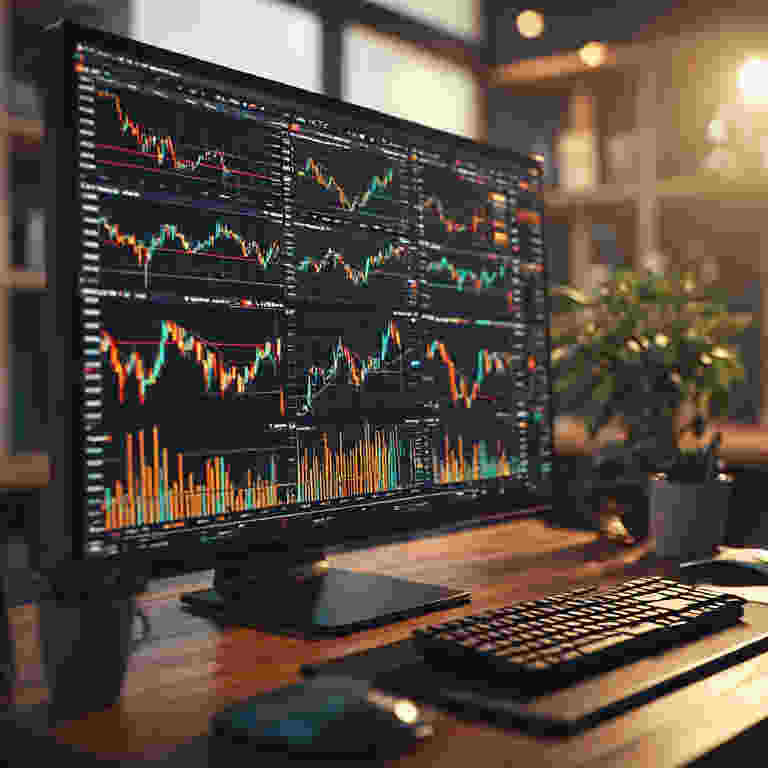
Backtesting and Forward Testing: Methodologies for Evaluating Trading Strategies
In quantitative finance and systematic trading, backtesting and forward testing represent two distinct, sequential phases in the empirical evaluation of a trading strategy, especially for technical traders. These methodologies allow practitioners to apply a structured, data-driven approach to assess the hypothetical or actual performance of a set of trading rules before committing significant capital. This article explains the definitions, processes, purposes, and inherent limitations of both backtesting and forward testing, without making claims about the future success of any specific approach. This article is not for financial advice and not a predictions of future price. Just a collection of information.
Part 1: Backtesting – Historical Simulation
1.1 Definition and Core Concept
Backtesting is the process of applying a defined set of trading rules to historical market data to simulate how the strategy would have performed in the past. It is a form of historical simulation that aims to quantify the strategy’s behavior, including its profitability, risk metrics, and sensitivity to different market conditions, using a known dataset.
1.2 The Backtesting Process
A systematic backtest typically involves several key steps:
- Strategy Definition: Explicitly codifying the trading rules. This includes precise criteria for:
- Entry Signals: Conditions that trigger the opening of a position (e.g., “Buy when the 50-day moving average crosses above the 200-day moving average”).
- Exit Signals: Conditions for closing a position, including both profit-taking and stop-loss rules.
- Position Sizing: Rules determining how much capital is allocated to each trade.
- Data Acquisition and Preparation: Obtaining clean, accurate historical data for the relevant assets. This data must include price (open, high, low, close) and volume, and often other relevant series like corporate actions (splits, dividends) for equities. The data period must be sufficiently long to capture various market regimes (bull, bear, sideways).
- Simulation Engine: Using software (from simple spreadsheets to specialized platforms like Python’s
backtrader,QuantConnect, or commercial tools) to “replay” the market day-by-day, applying the rules to the historical data to generate a simulated sequence of trades. - Performance Analysis: Calculating statistics from the simulated trade log. Common metrics include:
- Total Return / Net Profit
- Win Rate (percentage of profitable trades)
- Risk-Adjusted Returns (e.g., Sharpe Ratio, Sortino Ratio)
- Maximum Drawdown (largest peak-to-trough decline)
- Profit Factor (gross profit / gross loss)
1.3 Purpose and Utility
The primary purpose of backtesting is inferential. It allows a strategist to:
- Quantify a Strategy’s Historical Profile: Understand its average behavior, typical win/loss sizes, and volatility.
- Compare Alternative Rules: Test variations of a strategy to see which set of parameters performed more favorably under past conditions.
- Identify Logical Flaws: Discover unforeseen issues such as excessive trading frequency, vulnerability to specific events, or rules that are impossible to execute in reality.
1.4 Key Limitations and Pitfalls (The “Backtest Illusion”)
Backtesting results are inherently prone to biases that can make them misleading if not properly understood:
- Overfitting (Curve-Fitting): This is the greatest risk. It occurs when a strategy is excessively optimized to fit the random noise and specific patterns of the historical data, rather than capturing a robust, generalizable market principle. An overfit strategy performs exceptionally well on past data but fails on new, out-of-sample data.
- Look-Ahead Bias: Unintentionally using data that would not have been available at the time of the simulated trade. For example, using the day’s closing price to generate a signal that would require execution at the open.
- Survivorship Bias: Testing only on assets that exist today, ignoring those that failed, were delisted, or merged, which skews results upward.
- Simplified Assumptions: Backtests often assume perfect, instantaneous execution at the quoted price, ignoring real-world factors like slippage, commission costs, bid-ask spreads, and market impact, especially for larger orders.
Part 2: Forward Testing – Live Simulation
2.1 Definition and Core Concept
Forward testing, also known as paper trading or out-of-sample testing in real-time, is the process of running a fully defined strategy on live, incoming market data in real-time, but without executing trades with real capital. Trading decisions are simulated, and a hypothetical portfolio is tracked as if the trades were being executed.
2.2 The Forward Testing Process
- Strategy Finalization: The rules are frozen based on the backtesting phase. No further optimization is performed during the forward test.
- Real-Time Data Feed: The strategy logic is connected to a live market data feed.
- Paper Trading Execution: As market conditions meet the strategy’s predefined criteria, the platform simulates entries and exits. These “trades” are recorded in a hypothetical account, tracking P&L, positions, and all relevant metrics.
- Performance Monitoring: The strategist monitors the simulated performance under genuine, real-time market conditions, observing how the strategy reacts to news, gaps, and periods of high volatility that were not explicitly in the historical dataset.
2.3 Purpose and Utility
The primary purpose of forward testing is validation and refinement in a live environment.
- Validation of Backtest Results: It tests whether the strategy’s historical performance has any predictive value for its near-term, real-time performance.
- Testing Operational Reality: It reveals practical execution issues: Can signals be acted upon quickly enough? Are the assumed fill prices realistic? How does the strategy handle news-driven gaps?
- Psychological Preparation: It allows the trader to experience the emotional rhythm of the strategy’s wins and losses in real-time without financial risk.
- Final Refinement: Minor adjustments to execution logic (not core rules) may be made based on observed market microstructure.
Part 3: Comparative Analysis and the Development Pipeline
Backtesting and forward testing are complementary, not interchangeable. They are best used in sequence as part of a disciplined strategy development pipeline:
| Aspect | Backtesting | Forward Testing |
|---|---|---|
| Data Used | Historical (In-Sample Data) | Live, Real-Time (Out-of-Sample Data) |
| Environment | Closed, known simulation. | Open, unknown real-world simulation. |
| Primary Goal | Inference & Development – To discover and quantify a strategy’s logic and historical profile. | Validation & Operational Check – To verify the strategy holds up in real-time before capital commitment. |
| Key Risk | Overfitting to past noise. | Short Sample Size – A few months may not represent all market conditions. |
| Analogy | Studying for a driver’s license using a textbook and recorded videos of road scenarios. | Practicing driving in a closed, controlled parking lot with a real car and an instructor. |
The Typical Development Sequence:
- Idea Generation: A theoretical market hypothesis or pattern.
- Initial Backtest: Rapid prototyping on historical data to see if the idea has any merit.
- Robustness Testing & Optimization: Testing across multiple asset classes, time periods, and with careful avoidance of overfitting.
- Out-of-Sample Backtest: Running the finalized rules on a segment of historical data that was never used during development or optimization.
- Forward Test (Paper Trade): Running the strategy in real-time simulation for a meaningful period (e.g., 3-6 months).
- Live Execution (with small capital): Only after passing the previous stages is minimal real capital deployed, often scaled up gradually.
Conclusion: Tools for Informed Analysis, Not Guarantees
Backtesting and forward testing are essential tools in the toolkit of systematic traders and quantitative analysts. They provide a structured framework for moving from a theoretical trading idea to a quantitatively examined set of rules. However, they are diagnostic and analytical tools, not predictive ones.
A strong backtest does not guarantee future profits; it merely indicates what would have happened in the past under a specific set of assumptions. A successful forward test is a more stringent filter, but it remains a simulation. Both methods aim to increase the statistical confidence in a strategy’s underlying logic and its ability to function in a live market environment by rigorously challenging it with data. Their ultimate value lies in helping to identify and eliminate flawed strategies before real capital is at risk, thereby contributing to a more disciplined and researched approach to the markets.









2 comments