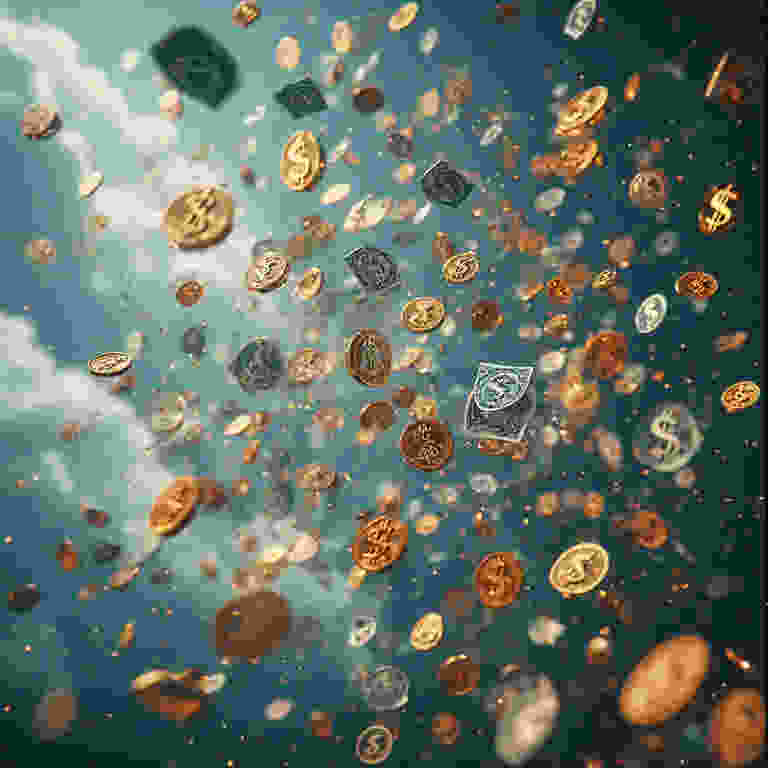
What Are Inflation and Deflation?
What Are Inflation and Deflation? : A Clear Guide to Their Meanings, Types, and Historical Origins. This article is not financial advice or prediction of any asset but for common knowledge only.
Inflation and deflation are two fundamental concepts in economics that describe changes in the general price level of goods and services over time. They have profound effects on purchasing power, economic growth, and everyday life.
Modern Definitions
Inflation occurs when the general price level rises over a sustained period. Each unit of currency buys fewer goods and services, reducing the purchasing power of money. It is typically measured by indices like the Consumer Price Index (CPI) or GDP deflator.
Deflation is the opposite: a sustained fall in the general price level. Money’s purchasing power increases, as the same amount buys more goods and services.
These are distinct from:
- Disinflation: A slowdown in the rate of inflation (prices still rise, but more slowly).
- Hyperinflation: Extremely rapid inflation (often >50% per month), eroding currency value dramatically.
- Stagflation: High inflation combined with stagnant growth and high unemployment.
Various Meanings and Types
Inflation
- Demand-Pull Inflation: Arises when aggregate demand exceeds supply, “pulling” prices up (e.g., strong consumer spending).
- Cost-Push Inflation: Driven by rising production costs (e.g., higher wages or raw materials).
- Built-In Inflation: Results from a wage-price spiral, where workers demand higher wages to match past price rises.
- Monetary Inflation (historical usage): An increase in money supply leading to currency devaluation. Some economist branches such as Austrian economist still use this.
Mild inflation (around 2% annually, as targeted by many central banks) is often seen as healthy, encouraging spending and investment.
Deflation
- Demand-Side Deflation: Caused by reduced consumer spending or economic contraction.
- Supply-Side Deflation: From productivity gains or technological advances increasing supply (sometimes “good” deflation).
- Debt Deflation: Falling prices increase the real burden of debt, leading to a downward spiral.
Prolonged deflation is generally harmful, discouraging spending (as people wait for lower prices) and worsening debt loads.
Historical Origins of the Terms
The word inflation comes from Latin inflare (“to blow into” or “inflate”), entering English in the 14th century for physical swelling. In economics, it first appeared in the mid-19th century (around 1838 in American English) to describe currency devaluation from excess money supply, especially paper money during the U.S. Civil War. Classical economists like David Hume and David Ricardo noted how oversupply of money depreciated its value, leading to higher prices. By the 20th century, the meaning shifted to directly mean rising prices, influenced by post-World War I debates.
Deflation emerged later as the counterpart, referring to contraction in money/credit supply or falling prices. It gained prominence in the 20th century, particularly during the Great Depression (1929–1939), when severe deflation exacerbated economic woes.
Notable Historical Examples
Inflation and deflation have shaped economies for millennia:
- Ancient Inflation: One of the earliest recorded occurred around 330 BCE in Alexander the Great’s empire, from captured precious metals flooding the money supply.
- 16th-Century Price Revolution: Massive silver/gold inflows from the Americas caused widespread inflation in Europe.
- Weimar Germany Hyperinflation (1921–1923): Post-WWI reparations led to extreme money printing; prices doubled every few days, requiring wheelbarrows of cash for basics.
- Great Depression Deflation: Prices fell sharply (nearly 7% annually in the U.S. from 1930–1933), creating a vicious spiral of reduced spending and debt burdens.
- Japan’s “Lost Decades” (1990s–2010s): Prolonged mild deflation from asset bubble burst and stagnation.
- Post-WWII: Many economies saw inflation from reconstruction, while commodity-based systems alternated inflation/deflation cycles.
In summary, inflation and deflation reflect imbalances in money supply, demand, or productivity. Their terms evolved from monetary phenomena to price-level descriptions, with history showing extremes can devastate economies while moderate levels support stability.











2 comments