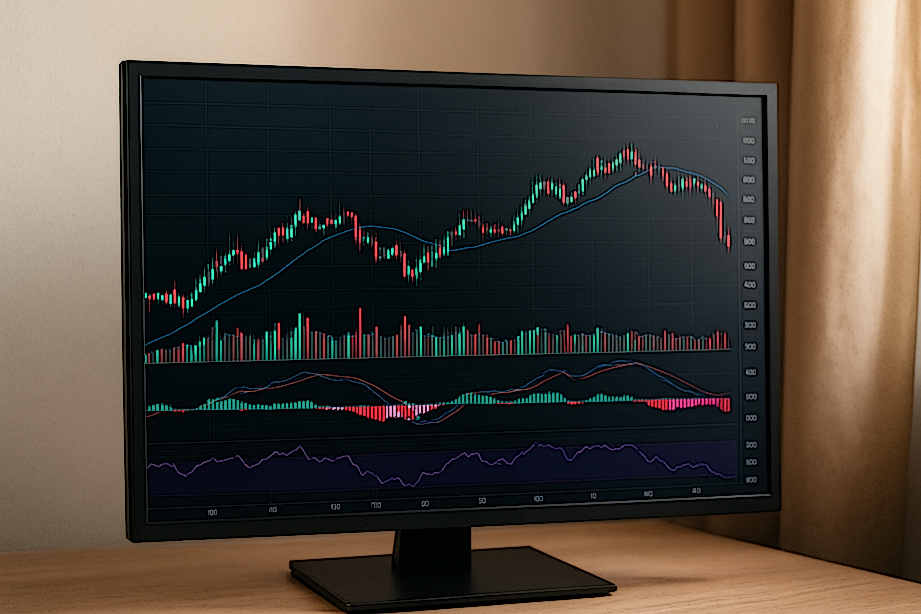
8 Ways to use MACD like a Pro
This article is not financial advice or prediction of any asset but only an opinion.
MACD (Moving Average Convergence Divergence) is one of the most powerful and flexible indicators available to traders in both Forex and Stock markets. Although most traders only use it for simple crossovers, the MACD can be applied in multiple profitable ways — if you understand its structure, timing, and context.
Below is a complete explanation of 8 profitable ways traders use the MACD, with detailed guidance and strategy logic for each.
1. The Classic MACD Line Crossover
Concept:
- This is the foundation of MACD trading — when the MACD line crosses the Signal line, it suggests a momentum change.
- Bullish signal: MACD line crosses above the signal line → potential uptrend.
- Bearish signal: MACD line crosses below the signal line → potential downtrend.
How to Use Profitably: Confirm with trend direction on higher timeframe.
Example: On the daily chart, trend is bullish → take only buy crossovers on the 1-hour chart.
- Combine with support/resistance or EMA trend filter (e.g., 50 EMA).
- Set stop-loss just beyond last swing low/high.
- Exit when opposite crossover occurs or when MACD histogram starts weakening.
Profit Potential: Simple yet powerful for swing trades or position trading. Works best in trending markets.
2. MACD Histogram Momentum Strategy
Concept: The histogram shows the difference between MACD and Signal lines. Expanding bars = increasing momentum; contracting bars = decreasing momentum.
How to Use Profitably:
- Look for histogram bars moving from negative to positive → early bullish momentum.
- Look for histogram bars shrinking after a long expansion → momentum loss = early warning of reversal.
- Enter trades before crossover when histogram starts expanding in your favor.
Example:
- When histogram moves from red (below zero) to green (above zero), enter a buy.
- When histogram peaks and starts shrinking, prepare to exit or tighten stop.
Profit Potential: Excellent for momentum timing — gives earlier signals than the line crossover, especially for short-term traders or scalpers.
3. MACD Zero-Line Crossover
Concept:
- When the MACD crosses the zero line, it confirms a trend direction change:
- MACD crossing above 0 = momentum turning bullish.
- MACD crossing below 0 = momentum turning bearish.
How to Use Profitably:
- Wait for MACD line to cross the zero line.
- Enter trades in direction of the crossover.
- Use it as trend confirmation after a breakout.
- Combine with moving averages or price structure.
Example: If MACD crosses above zero and price breaks resistance → confirm trend continuation.
Profit Potential: Best used for confirmation trades and trend-following strategies. Reduces false signals common in early entries.
4. MACD Divergence Trading
Concept:
A divergence happens when price and MACD move in opposite directions — signaling possible reversal.
Two Types:
- Bullish divergence: Price makes lower lows, MACD makes higher lows → potential bottom.
- Bearish divergence: Price makes higher highs, MACD makes lower highs → potential top.
How to Use Profitably:
- Identify divergence on higher timeframes (H4 or Daily).
- Wait for a MACD line crossover to confirm reversal.
- Enter after price confirms (breaks previous swing).
- Stop-loss below/above recent swing extreme.
Profit Potential:
One of the most reliable reversal methods, especially when combined with RSI divergence or trend exhaustion zones.
5. MACD Trend Continuation Setup (Pullback Entry)
Concept: Instead of trading reversals, you use MACD to re-enter a trend after pullbacks.
How to Use Profitably:
- Identify strong trend using 200 EMA or higher timeframe direction.
- Wait for MACD to pull back (cross against trend briefly).
- When MACD re-crosses in direction of main trend, enter trade.
Example:
- Uptrend: MACD dips below signal line (pullback) → re-crosses up → Buy.
- Downtrend: MACD rises above signal line → re-crosses down → Sell.
Profit Potential:
Highly profitable in sustained trending markets — it catches multiple trend legs with reduced risk.
6. MACD + RSI Confluence Strategy
Concept: RSI (Relative Strength Index) adds overbought/oversold confirmation to MACD’s momentum signals.
How to Use Profitably:
- Watch for MACD crossover or histogram reversal.
- Confirm with RSI:
- RSI < 30 and MACD turning bullish → Strong buy.
- RSI > 70 and MACD turning bearish → Strong sell.
- Enter when both indicators confirm.
Bonus Tip:
If RSI diverges and MACD also diverges in the same direction — extremely powerful reversal signal.
Profit Potential:
Improves accuracy by filtering false MACD signals that occur during sideways or choppy conditions.
7. Multi-Timeframe MACD Confirmation
Concept:
Combine MACD signals from multiple timeframes to improve trade accuracy.
How to Use Profitably:
- Check higher timeframe (Daily or 4H) MACD direction → defines market bias.
- Only trade in same direction on lower timeframe (1H or 15M).
Example: Daily MACD bullish → only take buy signals on 1H MACD crossovers.
Profit Potential: Prevents countertrend trades and keeps your entries aligned with dominant momentum.
Bonus: This method filters fake reversals that look profitable short-term but move against long-term flow.
8. MACD Breakout Confirmation
Concept: MACD can validate whether a breakout from support/resistance is strong or false.
How to Use Profitably:
- Watch for price breaking a significant level (trendline, channel, or horizontal zone).
- Check MACD histogram and line movement:
- If histogram expands strongly and MACD crosses zero → breakout confirmed.
- If histogram is weak or flat → likely fake breakout.
- Enter trade on breakout candle close + MACD confirmation.
Profit Potential:
Excellent for traders who suffer from false breakout traps — confirms momentum behind price moves.
.
Final Tips for Success using MACD
- Use higher timeframes (H1, H4, Daily) or Multi-Timeframe Analysis to reduce noise.
- Combine with support/resistance or moving averages.
- Adjust MACD settings for asset volatility
– Default (12, 26, 9) works well for stocks and majors.
– For faster markets (crypto, scalping), try (8, 21, 5). - Always check for divergence before major reversals.
- Avoid using MACD alone — use it as confirmation with price action.













2 comments