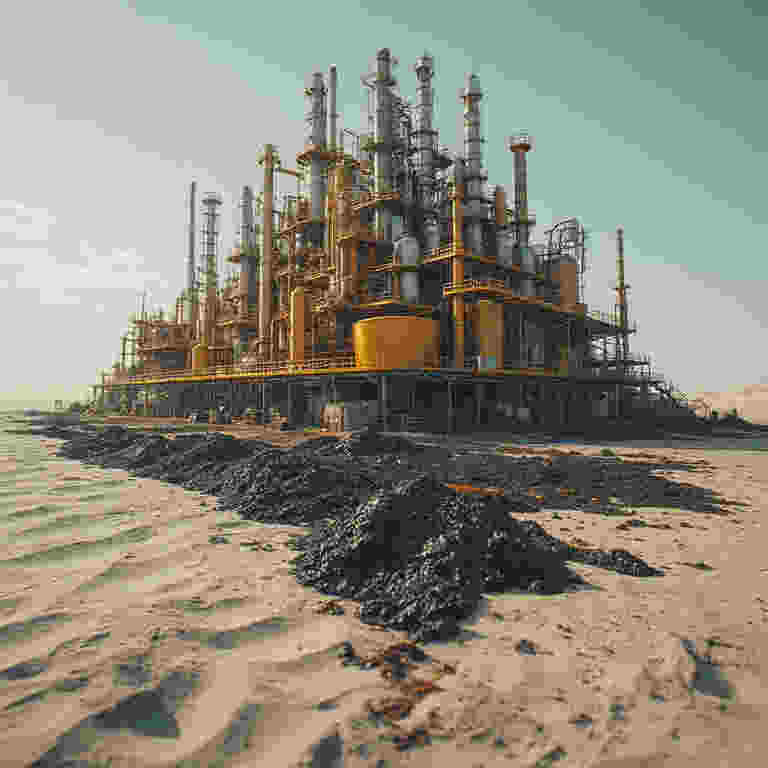
The Black Gold That Powers Our World
Crude Oil: Why Is it The Lifeblood of Modern Civilization and World’s Critical Commodity? Crude oil isn’t merely just one commodity in the commodity market—it’s the foundational energy source that has shaped the modern world. From the moment John D. Rockefeller built Standard Oil in the 19th century to today’s geopolitical struggles over energy security, crude oil has been the ultimate strategic asset, economic driver, and political instrument. This dense, ancient biomass, transformed over millions of years, has become the world’s most traded physical commodity and financial instrument, with daily trading volumes exceeding $100 billion. Its story is the story of modern civilization itself. This article is not for financial advice or but for general informative purpose only. This article does not mean to be all-time represent. The future readers should aware that information and facts in the future may change with the time and context.
Part 1: Crude Oil as Energy – The Engine of Global Civilization
The Physical Necessity: Why We Can’t Live Without It
Crude oil’s unique chemical properties make it the world’s most versatile energy source. With an energy density approximately 30 times greater than lithium-ion batteries and superior portability to natural gas or coal, oil became the perfect fuel for transportation—the circulatory system of global commerce. Approximately 60% of every barrel of oil is refined into gasoline, diesel, and jet fuel that powers our global mobility.
But oil’s significance extends far beyond transportation:
Transportation Revolution: The internal combustion engine and its descendants power 98% of the world’s transportation sector. Commercial aviation, global shipping (which moves 90% of world trade), trucking, and personal vehicles all run on petroleum derivatives. There is simply no scalable alternative that can match oil’s energy density and convenience for most transportation applications today.
Industrial Backbone: Approximately 15% of each barrel becomes petrochemical feedstocks—the building blocks for modern life. From these come plastics, fertilizers, pharmaceuticals, synthetic fibers, lubricants, asphalt, and thousands of other products. The global plastics industry alone consumes about 4-6% of world oil production.
Agricultural Transformation: The Green Revolution of the 20th century was powered by oil—both as fuel for mechanized farming and as feedstock for nitrogen-based fertilizers through the Haber-Bosch process. Modern agriculture is essentially a method of converting petroleum into food, with approximately 10 calories of fossil fuel energy required to produce 1 calorie of food energy in conventional systems.
Economic Growth Correlation: For over a century, economic growth has been virtually synonymous with increased energy consumption, with oil at the center. Every 1% increase in global GDP has historically required about 0.5% increase in oil consumption, a relationship that has only recently begun to decouple in advanced economies.
Part 2: Crude Oil as Trading Commodity – The World’s Largest Market
The Birth of Modern Oil Trading
The transformation of oil from a physical necessity to a financial instrument began with the 1973 Arab oil embargo, which led to the creation of the spot market. This was revolutionized in 1983 when the New York Mercantile Exchange (NYMEX) launched the first crude oil futures contract for West Texas Intermediate (WTI), followed by the Intercontinental Exchange’s Brent crude contract. These standardized contracts created price discovery mechanisms that now serve as global benchmarks.
Market Structure and Participants
Benchmarks Define the World:
- Brent Crude: A blend from North Sea fields, serving as the benchmark for 60% of global oil trade, especially in Europe, Africa, and the Middle East
- West Texas Intermediate (WTI): The U.S. benchmark, known for higher quality and lighter characteristics
- Dubai/Oman: The Asian benchmark for Middle Eastern crude
- OPEC Basket: A weighted average of crudes from OPEC members
- And others
Market Participants Form an Ecosystem:
- Producers: National oil companies (Saudi Aramco, Rosneft) and international oil companies (ExxonMobil, Shell)
- Consumers: Refiners, airlines, shipping companies, and industrial users
- Traders: Physical traders (Vitol, Trafigura, Glencore) and financial players (hedge funds, banks, ETFs)
- Market Makers: Investment banks and proprietary trading firms providing liquidity
- Speculators: Hedge funds, CTAs, and retail traders influencing short-term price movements
Trading Instruments Create a Complex Web:
- Physical Markets: Actual barrels changing hands at specific locations
- Futures and Options: Exchange-traded derivatives for hedging and speculation
- Swaps, CFDs, and OTC Derivatives: Customized instruments traded privately
- ETFs and ETNs: Retail-accessible products like USO (United States Oil Fund)
Part 3: Price Dynamics – What Moves the Oil Market
The Fundamental Equation: Supply and Demand
Supply Factors:
- OPEC+ Decisions: The cartel controlling approximately 40% of global production and 60% of reserves
- U.S. Shale Production: The “swing producer” that can respond quickly to price signals
- Geopolitical Events: Wars, sanctions, pipeline disruptions, and political instability
- Technological Advancements: Fracking, deepwater drilling, and enhanced recovery techniques
- Investment Cycles: The 5-10 year lag between investment decisions and production
Demand Factors:
- Global Economic Growth: Particularly from emerging economies
- Seasonal Patterns: Summer driving season and winter heating demand
- Transportation Trends: Electric vehicle adoption and efficiency improvements
- Industrial Activity: Manufacturing PMIs and chemical production
- Policy Shifts: Carbon taxes, subsidies, and environmental regulations
The Financialization Factor
Since the 2000s, oil has become increasingly financialized. The volume of paper barrels traded now dwarfs physical barrels by approximately 30:1. This financialization means that:
- Oil prices increasingly respond to financial flows and investor sentiment
- The dollar’s strength inversely correlates with oil prices (since oil is priced in dollars)
- Interest rates affect carrying costs and inventory decisions
- Broader market risk sentiment (VIX) spills into commodity markets
Part 4: Strategic Significance – Oil as Geopolitical Instrument
The Resource Curse and Petro-Politics
Oil wealth has created unique political economies in producing nations—the so-called “resource curse.” Countries like Saudi Arabia, Russia, Venezuela, and Nigeria demonstrate how oil revenues can distort governance, creating rentier states where governments distribute wealth rather than tax citizens, fundamentally altering the social contract.
Energy Security and Strategic Reserves
Major consuming nations maintain strategic petroleum reserves (the U.S. holds 714 million barrels, approximately 30 days of supply) as insurance against supply disruptions. The International Energy Agency requires members to maintain 90 days of net import coverage. These reserves can be released during price spikes to stabilize markets, as seen in 2022 following Russia’s invasion of Ukraine.
The Petrodollar System
Since the 1974 U.S.-Saudi agreement, oil has been priced and traded predominantly in U.S. dollars, creating what economists call the “petrodollar recycling” system. This arrangement:
- Creates constant global demand for dollars
- Allows the U.S. to run persistent trade deficits
- Gives the U.S. financial system privileged status
- Provides Washington with geopolitical leverage through dollar-based sanctions
Recent moves by China, Russia, and some Middle Eastern countries to trade oil in alternative currencies (yuan, rubles, local currencies) represent the most significant challenge to this system in 50 years.
Part 5: Economic Impact – The Inflation Engine
Oil Prices and the Global Economy
The correlation between oil prices and economic activity is so profound that economists have identified specific thresholds:
- Sustained prices above $100/barrel typically trigger global recessions (1973, 1979, 2008, 2022)
- Prices below $20/barrel can bankrupt producers but stimulate consumer economies
- The “Goldilocks zone” for balanced growth has historically been $50-80/barrel
The Inflation Transmission Mechanism
Oil price shocks flow through economies via several channels:
- Direct Effects: Higher gasoline and heating costs immediately reduce household disposable income
- Cost-Push Inflation: Transportation costs increase prices for all goods
- Input Costs: Petrochemical-dependent industries face rising production costs
- Expectations: Persistent high energy prices embed inflation expectations in wage demands
Central banks monitor oil prices when making monetary policy decisions. The “core inflation” measure excludes food and energy precisely because their volatility could distort policy responses, but sustained oil price increases inevitably bleed into core measures.
Part 6: The Energy Transition – Oil’s Existential Challenge
Peak Demand vs. Peak Supply
The conversation has shifted from “peak oil supply” (the fear of physical depletion) to “peak oil demand” (the economic displacement by alternatives). The International Energy Agency forecasts global oil demand may peak before 2030, though OPEC projects continued growth into the 2040s.
The Stranded Assets Risk
Approximately $1.3 trillion in oil and gas investments could become “stranded assets”—worthless due to climate policies or technological disruption. This creates a paradox: producers need continued investment to maintain production, but investors increasingly see long-term demand uncertainty.
The Green Premium and Cost Curves
As renewable energy costs plummet (solar and wind now cheaper than new fossil fuel plants in most markets), oil faces unprecedented competition in electricity generation. However, transportation (particularly aviation and shipping) and petrochemicals remain challenging sectors to decarbonize, ensuring oil demand persists for decades in specific applications.
Part 7: Market Behavior
The Contango-Backwardation Cycle
The shape of the futures curve (contango when distant prices exceed spot prices, backwardation when spot exceeds distant) reveals market psychology and physical market tightness. This structure creates profitable trading strategies:
- Cash-and-Carry: Buying physical oil, storing it, and selling futures in contango markets
- Calendar Spreads: Trading the price differential between contract months
- Crack Spreads: Refining margins (crude oil vs. petroleum product prices)
- Location Arbitrage: Exploiting price differences between regions (Brent-WTI spread)
Volatility Patterns and Seasonality
Oil exhibits characteristic volatility patterns:
- Higher volatility during geopolitical crises and inventory reports
- Seasonal strength in summer (driving season) and winter (heating demand)
- “Gamma squeezes” around option expiration dates
- Inventory data releases (EIA weekly reports) creating regular price movements
Conclusion: The Indispensable Commodity at a Crossroads
Crude oil remains the world’s most significant commodity because it sits at the intersection of energy, finance, geopolitics, and environmental sustainability. No other substance has so completely shaped the modern world—from the suburbanization of America made possible by cheap gasoline to the geopolitical alliances and conflicts centered on oil-producing regions.
As both a physical energy source and a financial instrument, oil demonstrates unique characteristics:
- Non-substitutability in key applications (aviation, petrochemicals)
- Inelastic short-term demand (people still need to drive even as prices rise)
- Long investment cycles creating boom-bust price cycles
- Geographical concentration of reserves creating strategic vulnerabilities
- Environmental externalities creating climate change imperatives
The coming decades will test whether crude oil can maintain its dominance or gradually cede ground to alternatives. What’s certain is that the transition will be neither linear nor simple. The world’s dependence on oil was built over 150 years; unwinding it will require similar timeframes, trillions in investment, and technological breakthroughs we can only imagine today.
Until then, crude oil remains what it has been since the first well was drilled in Pennsylvania in 1859: the lifeblood of industrial civilization, the world’s most strategic commodity, and the ultimate barometer of global economic health. Understanding oil isn’t just about understanding energy markets—it’s about understanding how our world actually works.